Working papers
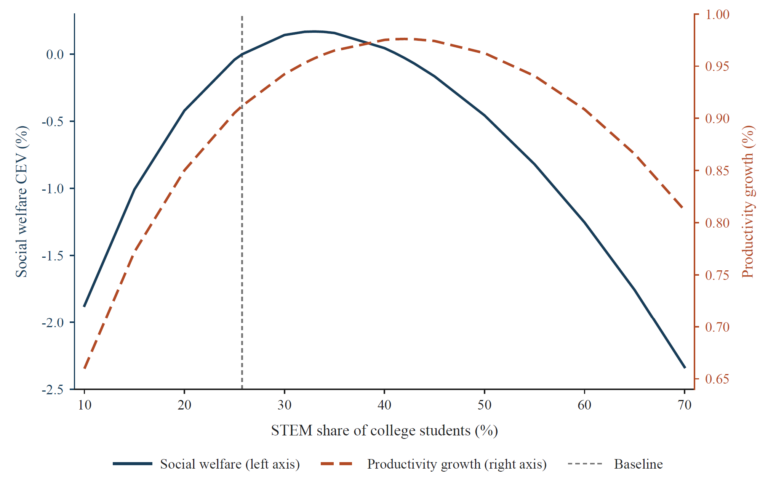
Abstract: We develop a general-equilibrium life-cycle model with major choice, career choice, and endogenous innovation to evaluate STEM education policies. [more] [less]
Governments promote STEM education to raise productivity and narrow gender gaps. We develop a general-equilibrium life-cycle model with major choice, career choice, and endogenous innovation to evaluate such policies. A moderate STEM expansion increases welfare and growth, but further expansion draws students from better-fitting majors and reduces research capacity. At similar costs, general tuition aid yields the largest welfare gain, while STEM subsidy delivers the largest growth response. Female-targeted STEM policy increases women's representation and narrows the earnings gap, but heavy targeting lowers welfare. Education aid can also outperform direct R&D subsidies by expanding researcher supply and reducing labor costs.
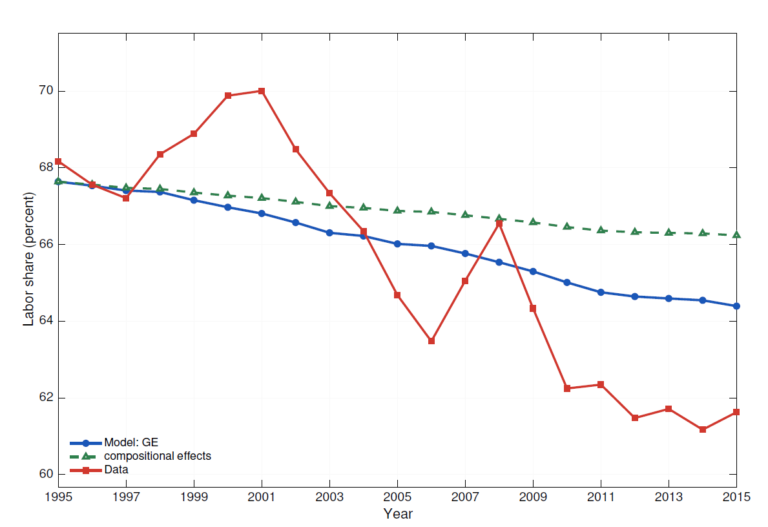
Abstract: Workforce aging generally decreases labor mobility and bargaining strength even when older workers remain valuable hires, because they search less and are harder to poach. [more] [less]
Workforce aging generally decreases labor mobility and bargaining strength even when older workers remain valuable hires, because they search less and are harder to poach. For example, U.S. industry-level evidence shows that aging reduces employer-to-employer (EE) flows, job creation, labor share, and firm's vacancy creation, while individual-level evidence shows that wage gains from EE flows decline with age. In a general-equilibrium life-cycle search model with on-the-job search and endogenous bargaining, aging explains half the 1995–2015 decline in labor share. The shift in workforce composition toward older workers accounts for 40% of this decline, while the balance reflects the resulting decline in vacancy creation responses by firms. Vacancy subsidies and moderate unemployment-benefit cuts substantially restore the labor share.
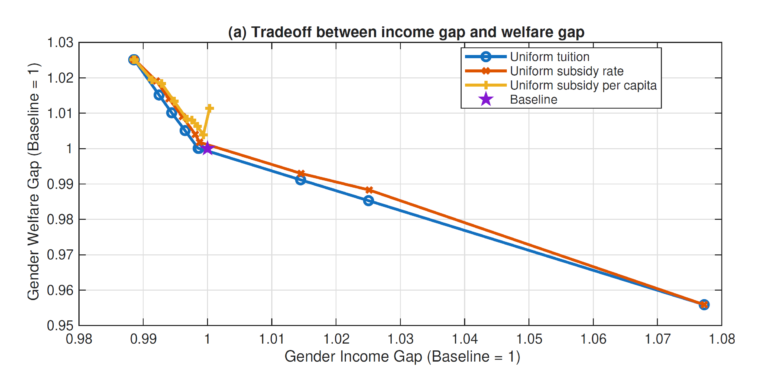
Abstract: This paper examines how higher-education policy impacts gender inequality when students decide both college attendance and major selection. [more] [less]
This paper examines how higher-education policy impacts gender inequality when students decide both college attendance and major selection. We develop a quantitative life-cycle model incorporating endogenous college enrollment, college major, saving, and fertility. Policies can shift Gender Income Gap and Gender Welfare Gap in opposite directions by altering student sorting across fields. Universal free tuition may widen the income gap while narrowing the welfare gap. Conversely, gender-based affirmative action has minimal effect on earnings gaps but can worsen welfare disparities. Evaluating policy solely through earnings gaps may be misleading when there exists gender heterogeneity by major.
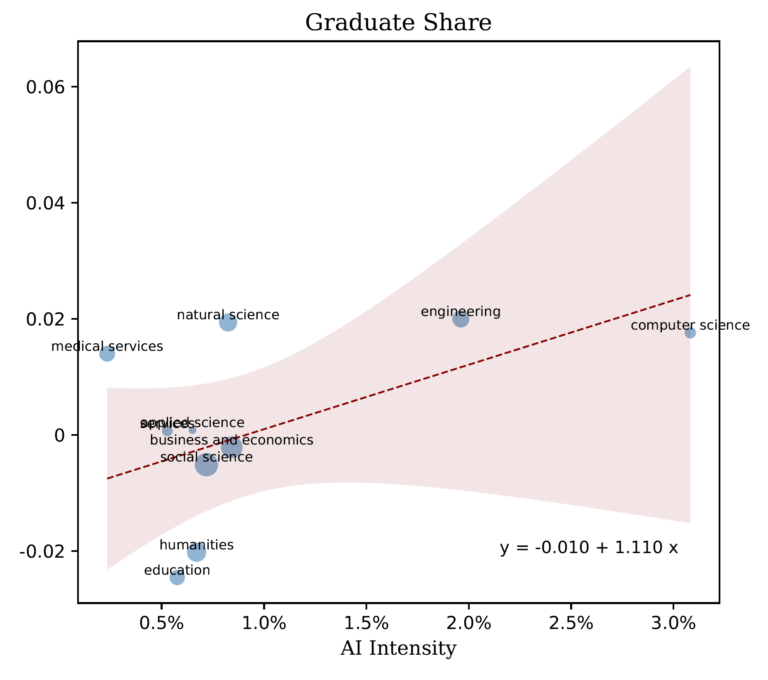
Abstract: This paper studies how the diffusion of artificial intelligence reshapes human capital investment and local labor market outcomes. [more] [less]
This paper studies how the diffusion of artificial intelligence reshapes human capital investment and local labor market outcomes. Using Lightcast job postings and American Community Survey data, we construct location-level AI labor demand shocks and identify their effects with a shift-share IV design. Higher AI demand reallocates college majors toward AI-adjacent fields—especially computer science and engineering—and away from education and humanities. Dynamic estimates show persistent relative gains in these AI-adjacent STEM fields and relative declines in humanities, business and economics after 4 years. On the extensive margin, AI demand has limited effects on aggregate college enrollment and the college wage premium. AI demand also raises local income on average, with gains concentrated in initially richer locations, leading to spatial disparity.
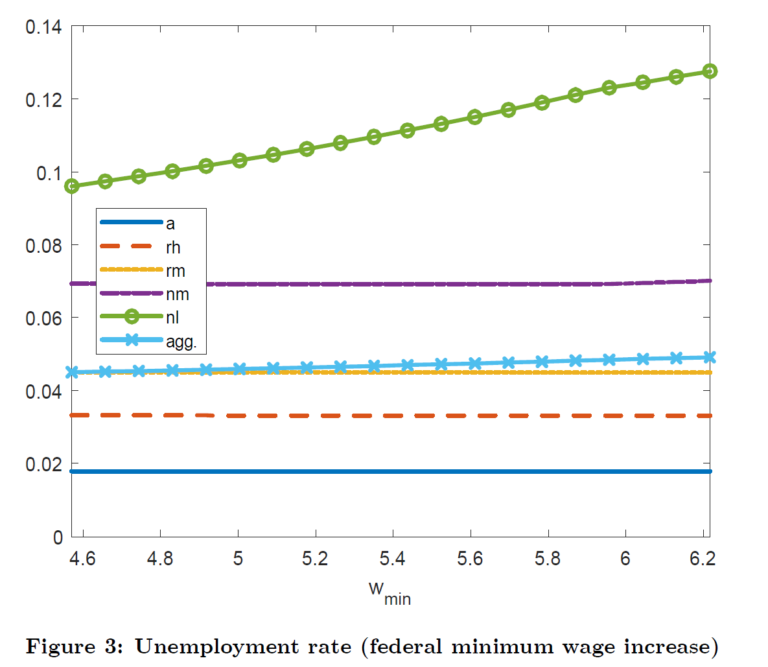
Abstract: While minimum wage policy is widely adopted in the real world, can it effectively raise the average wage of lower paid jobs without having large detrimental consequences for employment? [more] [less]
While minimum wage policy is widely adopted in the real world, can it effectively raise the average wage of lower paid jobs without having large detrimental consequences for employment? The empirical literature fails to establish robust findings. We develop a general-equilibrium search and wage-posting framework with heterogeneous workers and tasks matching in multi-tier labor markets: abstract, routine high-skilled, routine middle-skilled, manual middle-skilled and manual low-skilled. We incorporate rich cross-market spillovers and compositional effects from individual responses to market thickness. As a result of minimum wage hikes, we show that (i) the unemployment rate at the minimum wage binding market is higher, while all other markets enjoy a lower unemployment rate; (ii) employment in the manual low-skilled jobs is lower, whereas employment in the routine high-skilled and manual middle-skilled markets is higher due to cross-market substitutions; and, (iii) employment in other markets has ambiguous responses due to conflicting effects on potential worker entry and unemployment. By calibrating the model to fit the U.S. data, we evaluate the impacts of the federal minimum wage hike (2007-2009) and the on-going minimum wage increase in Seattle (2017-2021). We find that the minimum wage effects on employment on the binding markets depend crucially on the magnitudes of spillover and compositional effects and that the employment effects may be weak in a nonbinding market. Moreover, our results suggest that, while both minimum wage hikes reduce aggregate output, they only generate small effects on submarket average and overall average wages.
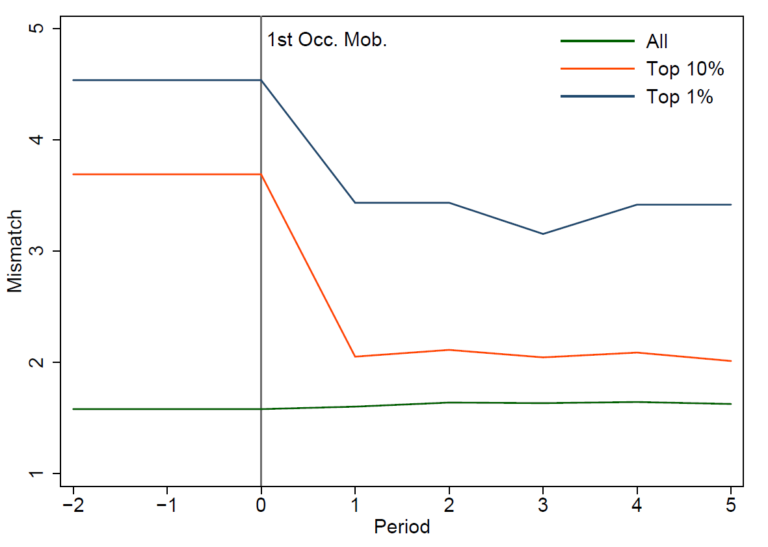
Abstract: This paper studies the connection between multidimensional skill mismatch and labor mobility decisions, and the implications on the aggregate economy thereof. [more] [less]
This paper studies the connection between multidimensional skill mismatch and labor mobility decisions, and the implications on the aggregate economy thereof. We show empirically that higher skill mismatch induces workers to move to a better matched job. Occupational mobility increases by 0.7 p.p. if skill mismatch increases by 1 standard deviation. Moreover, labor mobility helps reduce skill mismatch, especially for those previously with high skill mismatch. An equilibrium search model featuring skill mismatch and on the job search is developed. Quantitatively, we find that (i) skill mismatch has an important role to play in affecting the labor mobility decisions, as well as the aggregate economy, (ii) about two-thirds of the total skill mismatch can be accounted for by search frictions, which explain half of the occupational mobility and cost about 1% of the aggregate output and welfare, and (iii) aggregate productivity growth has positive impact on both the skill mismatch and occupational mobility.
PUBLICATIONS
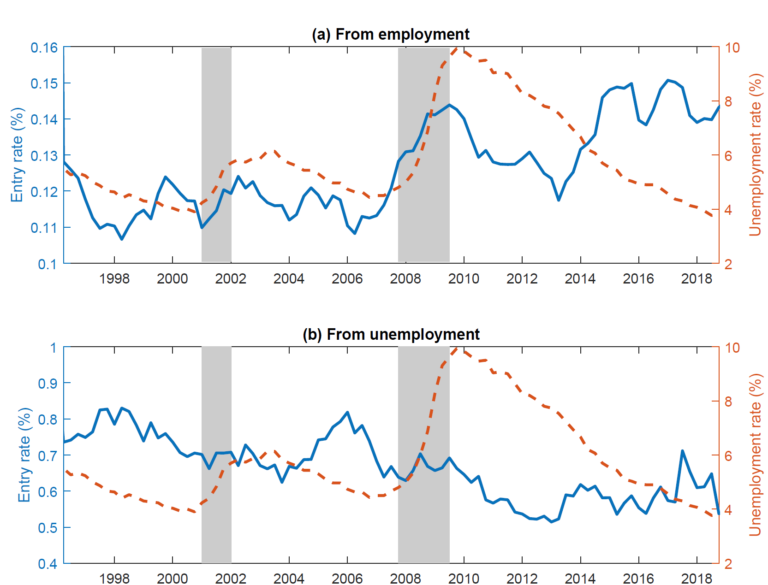
Abstract: This paper examines the dynamics of entrepreneurial entry during recessions, with heightened unemployment risk. [more] [less]
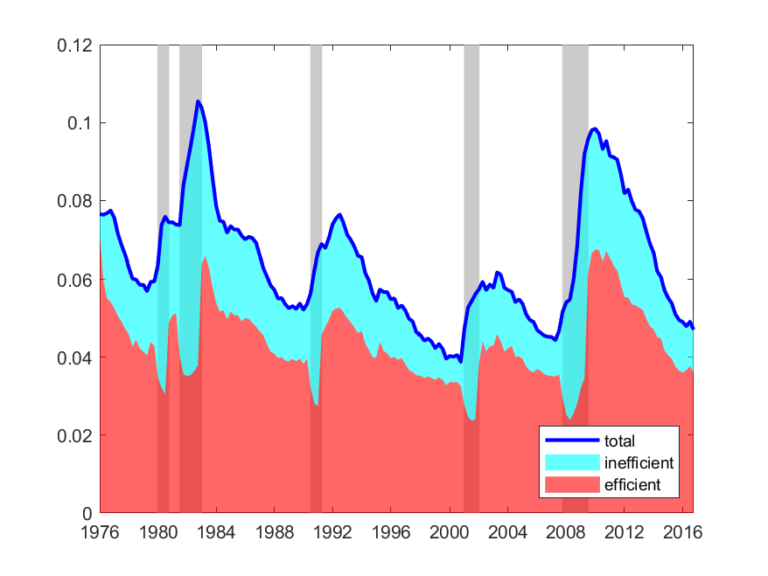
Abstract: This paper examines how bargaining frictions generate privately inefficient job separations and amplify unemployment fluctuations. [more] [less]
This paper examines how bargaining frictions generate privately inefficient job separations and amplify unemployment fluctuations. I propose a simple specification of bargaining friction by including bargaining wedges in the standard Nash bargaining model. Such bargaining wedges arise when, for example, wages are determined by alternating offers bargaining, which is often used in the literature to generate real wage rigidity, or when there is asymmetric information about worker's productivity. I show that due to the misalignment between actual surpluses and bargaining surpluses, inefficient separations could be generated, which would in turn induce inefficient unemployment. I highlight a distinct amplification mechanism that operates through the separation margin. The existence of inefficient unemployment due to bargaining friction could accentuate the fluctuation of unemployment. Quantitatively, I find that inefficient unemployment accounts for up to 30% of the total unemployment volatility in the calibrated model.
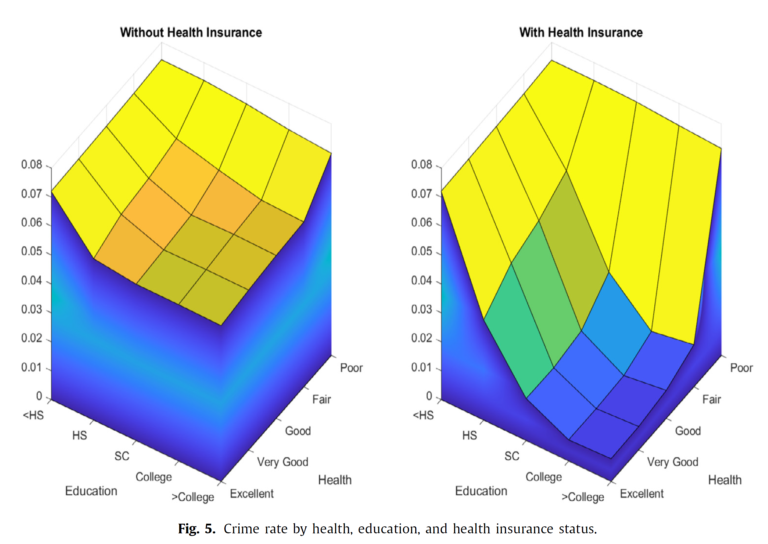
Abstract: Better health improves labor market outcomes, and better labor market outcomes discourage individuals from engaging in criminal behavior. [more] [less]
Better health improves labor market outcomes, and better labor market outcomes discourage individuals from engaging in criminal behavior. Therefore, health insurance policies would affect labor market outcomes and criminal behavior. To explain the mechanism and the impact, we build an equilibrium search model of health, crime, and the labor market. We then use the model to conduct policy experiments and quantify their impacts on the economy. The calibrated model shows that the Medicare-for-all and the Employer Mandate under the Affordable Care Act would increase the aggregate output by more than 10%. However, while Medicare-for-all reduces the crime rate and inequality, the Employer Mandate increases both. Furthermore, policy effects vary by individual’s skill and health status.
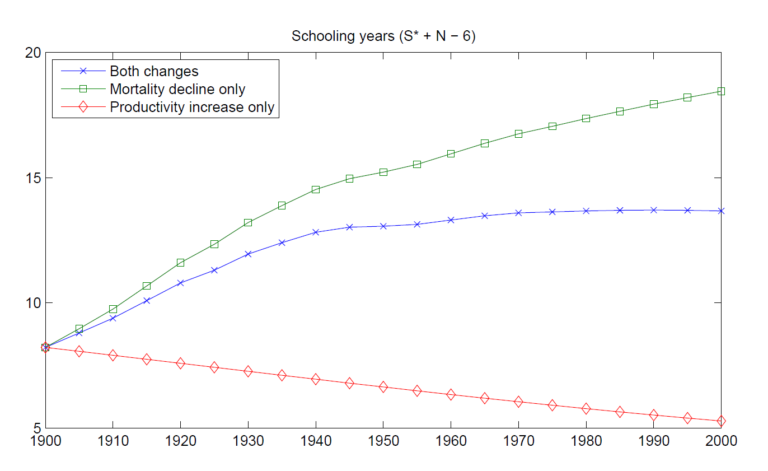
Abstract: The twentieth century has seen a phenomenal decline in mortality and an increase in productivity level. [more] [less]
The twentieth century has seen a phenomenal decline in mortality and an increase in productivity level. These two important events likely affect people's choices of schooling years and retirement age. We first show that in a standard life-cycle model, positive feedback exists between optimal schooling years and retirement age choices. We then evaluate the impact of a mortality or productivity shock on an endogenous variable (schooling years or retirement age) by decomposing it into the direct and indirect effects, where the indirect effect arises from feedback from the other endogenous variable. Finally, we extend the model by including the utility benefit of schooling and show that a negative correlation of schooling years and retirement age is possible. Apart from clarifying the apparently similar concepts of positive co-movement and positive feedback, our results have implications relevant to the economic demography literature.
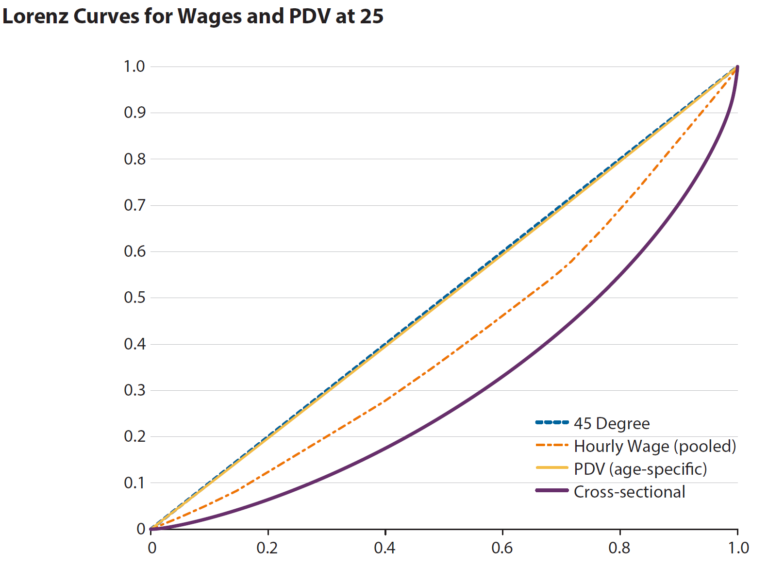
Abstract: People's occupations have a significant amount of information about their wages. [more] [less]
People's occupations have a significant amount of information about their wages. However, because people—especially young workers—go through multiple occupations and employment statuses during their working lives, we find that their occupations at a young age do not predict their lifetime earnings well. When educational attainment and gender are considered, we find that across education-gender groups the differences in lifetime earnings are even larger than the differences in average occupational wages: Workers in high-wage education-gender groups (men with college degrees, for example) work more (at the extensive margin) and are more likely to have higher-paying occupations.